
 Search
.jpg "Tibetan Local Travel Agency")


Sichuan Tibet Tour: How to Plan the Perfect Trip from Sichuan to Tibet
Sichuan, one of the main hubs for transport and communications in western China, is a vital link between the east and west of China. It is also a major gateway to Tibet due to its strategic location near Tibet, which offers the most frequent flights and the most scenic highway and railway to Tibet.
Known for cute pandas, delicious cuisine, rich history, and breathtaking landscapes, Sichuan itself is also a popular tourist destination that is worth a visit.
In this guide, we’ll provide detailed information on how to travel from Sichuan to Tibet, along with useful tips on how to make the most of your time in Sichuan before heading to Tibet.
 How to Travel from Sichuan to Tibet?
When is the Best Time to Visit Sichuan and Tibet?
Top Things to Do in Sichuan before Heading to Tibet
Pay Attention to the Altitude Changes from Sichuan to Tibet
Get Your Tibet Travel Permit In Advance Before Leaving Sichuan
Where is Sichuan and Tibet?
Sichuan Province and the Tibet Autonomous Region are two closely connected regions located in southwestern China. Sichuan Province is bordered to the west by the Tibet Autonomous Region, and the western part of the province is actually on the lower part of the Tibetan Plateau.
The Tibet Autonomous Region is located in the southwest of China, on the Qinghai-Tibet Plateau. It lies to the west of Sichuan and borders Nepal, India, Bhutan, and Myanmar to the south and west. The Himalayas, located on the southern edge of Tibet, form a natural border between Tibet (China) and these countries.
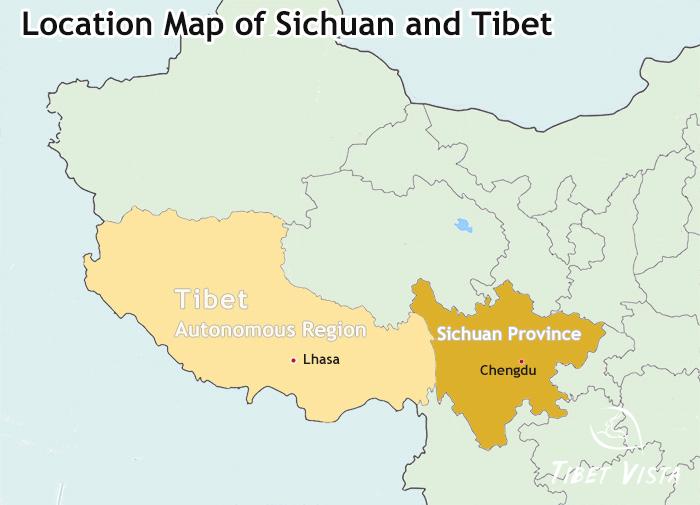 Sichuan Tibet Location Map
How to Travel from Sichuan to Tibet?
Sichuan offers the most convenient and efficient transfer options to Tibet, whether by air or by land, making it an ideal gateway for you heading to Tibet.
The fastest way to travel from Sichuan to Tibet is taking the 2.5-hour direct flight from Chengdu to Lhasa. Every day, there are over 25 non-stop flights flying from Chengdu to Lhasa, operating from 6:30 a.m. to 8:00 p.m. Besides the convenient flights to Lhasa, Chengdu also has direct flights to Nyingchi, the major city in eastern Tibet at around 3,040 meters above sea level. It takes only 2 hours and 15 minutes to fly from Chengdu to Nyingchi.
 Flights to Tibet from Chengdu offer the most convenient way to travel.
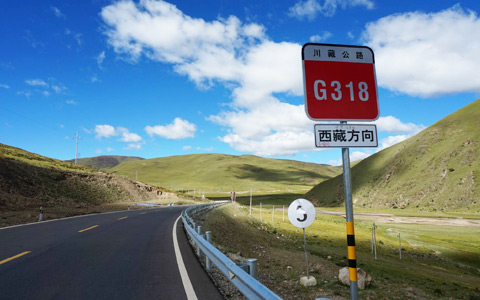
The most scenic travel from Sichuan to Tibet is overland through the most beautiful highway to Tibet, the G318 National Highway. Starting from Chengdu, you will drive west to Tibet along the scenic Sichuan-Tibet Highway, which is also a part of the G318 National Highway. You will pass through picturesque valleys and quaint Tibetan villages, the vast grassland and towering snow-capped mountains in west Tibet, and lush forests in eastern Tibet. The Chengdu to Lhasa overland tour generally takes 7 days via the scenic Sichuan-Tibet highway.
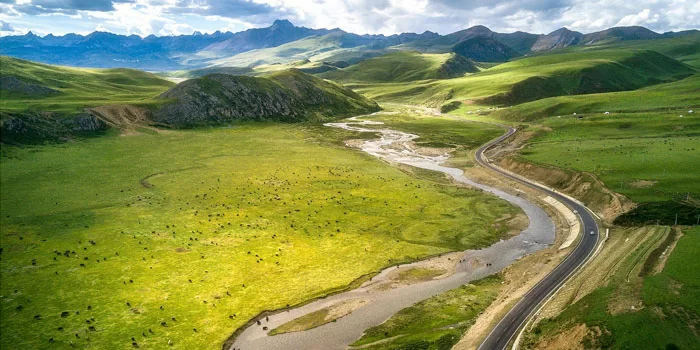

This is the most popular overland journey from Chengdu to Lhasa via the scenic G318 National Highway.
There are also trains from Sichuan to Tibet. Train Z322 departs every other day from Chengdu to Lhasa via the famous Qinghai-Tibet Railway. The Chengdu to Lhasa train runs through Lanzhou and Xining, crossing Qinghai Province and entering Tibet from the north, across the Tanggula Mountains, along the Qinghai Tibet Railway. The whole journey covers 3,070 kilometers in total and takes about 34.5 hours.
 Taking a train from Chengdu to Lhasa is a unique way to travel through the Tibetan Plateau.
Moreover, a high-speed railway from Sichuan to Tibet is currently under construction and is expected to be completed in 2030. Once finished, the train journey will be shortened to around 13 hours by bullet train via the east-west railway.
When is the Best Time to Visit Sichuan and Tibet?
The best time to visit Sichuan and Tibet is from April to May and September to October, when the weather is mild and landscapes are at their most beautiful. It is also the best time to visit Everest Base Camp in Tibet, during which you will appreciate the stunning clear views of Mount Everest and the Himalayas.
Summer is a good time to visit the grassland of west Sichuan, when the flowers are blossoming and the grasslands are green. However, July and August are rainy seasons along the Sichuan-Tibet highway, which may cause natural disasters such as mudslides in mountain areas. Therefore, it is suggested to avoid driving from Sichuan to Tibet in the rainy season, or you need to pay special attention to the weather forecast and road conditions.
Winter is not too cold to visit most destinations in Sichuan and Tibet. Even Everest Base Camp in Tibet remains open to tourists during the winter months. But in high-altitude areas like Mount Kailash and Lake Namtso, roads may be blocked due to heavy snow. Generally, it is not possible to visit Mount Kailash from late October to early April.
Insider Tips:
Both Chengdu and Lhasa can be visited all year round. However, due to the complex terrain and diverse topography of the Sichuan Basin and the Tibet Plateau, the best time to visit different areas varies. Feel free to share your travel ideas with us, and our professional travel consultant will provide tailored recommendations for the best time to visit your ideal destinations.
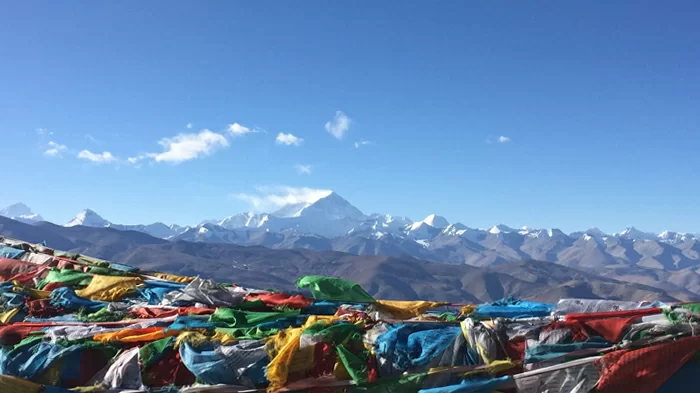 To see clear views of the Himalayas and Mount Everest in Tibet, avoid visiting during the rainy season.
Top Things to Do in Sichuan before Heading to Tibet
Sichuan is not only the home of giant pandas and Sichuan cuisine, it is also the only province that owns five UNESCO World Heritage sites in China. If you decide to stay in Sichuan for a while, you may consider the following top 7 things to do to appreciate the unique charm of Sichuan Province.
Top 1: Meet the Lovely Pandas at Chengdu Panda Base
The Chengdu Research Base of Giant Panda Breeding, also known as the Chengdu Panda Base, is the best place to see the lovely pandas, not only in Sichuan Province but also in the world. You can get up close to those lovely pandas, watch them play, eat bamboo, and interact in a natural habitat. Generally, it takes half a day to explore the panda base. In order to see more and more active pandas, it is recommended to visit in the morning.
 Don't miss a chance to see lovely giant pandas at the Chengdu Panda Base when you visit Sichuan.
Top 2. Savor Authentic Sichuan Cuisine
Sichuan cuisine is renowned worldwide for its strong fragrance and freshness, earning it the title of one of the four great traditional types of Chinese cuisine. During your days in Sichuan, especially in Chengdu, don’t miss a chance to experience the authentic Sichuan Hot Pot. There are also many street snacks and local dishes worth trying. You can go to Chunxi Road, Kuanzhai Alley, and other places to enjoy these delicacies.
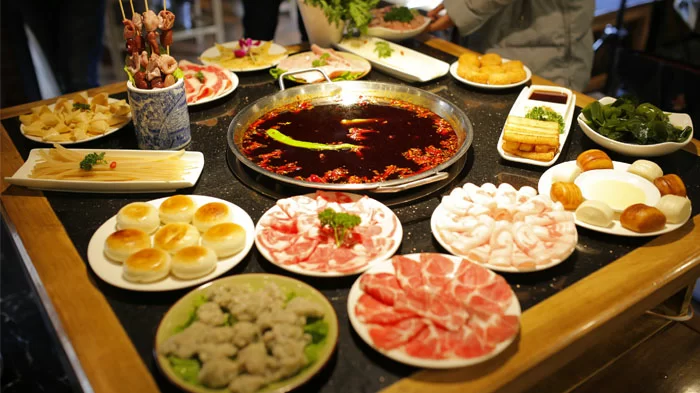 Sichuan hot pot is a must-try dish for a Sichuan Tibet tour.
Top 3. Marvel at the Beauty of Jiuzhai Valley
Jiuzhaigou Valley, a UNESCO World Heritage site, is famous for its colorful lakes, crystal waterfalls, dense forests, and snow-capped peaks. Covering an area of over 180,000 acres, it consists of three valleys that together form a Y-shape: Rize Valley, Zechawa Valley, and Shuzheng Valley, all of which can be toured by shuttle bus.
Traditionally, it takes 4 days to visit Jiuzhaigou Valley from Chengdu by overland. Thanks to the newly-built high-speed rail, now you can take a bullet train from Chengdu to Jiuzhaigou within 2 hours, which makes a Chengdu to Jiuzhaigou Valley tour in 2 days.
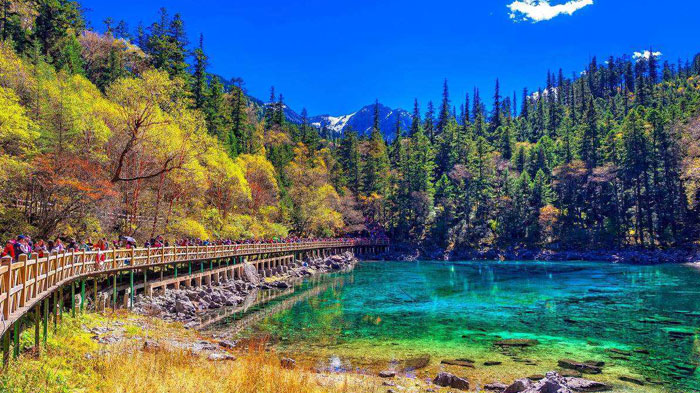 Enjoy the stunning colorful lakes in Jiuzhaigou Valley Natural Reserve.
Top 4. Visit the Leshan Giant Buddha and Mount Emei
Located 150 kilometers from Chengdu, the Leshan Giant Buddha is the world’s largest stone Buddha statue, standing at 71 meters tall and overlooks the confluence of three rivers. You can choose to explore the Giant Buddha on foot or take a boat tour for a panoramic view according to your time and physical condition.
 View the Leshan Giant Buddha from the tourist boat.
Just 41 kilometers from the Leshan Giant Buddha is Mount Emei, one of China’s Four Sacred Buddhist Mountains, which offers stunning landscapes, ancient temples, and a serene atmosphere for spiritual reflection and hiking.
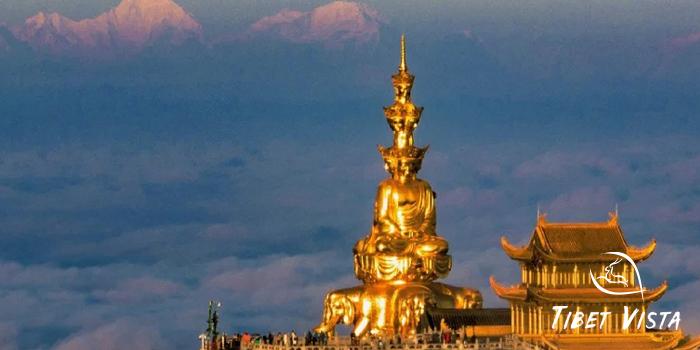
This trip combines visits to the Leshan Giant Buddha, Mount Emei, and Everest Base Camp.
Top 5. Explore Taoism in Qingcheng Mountain
Mount Qingcheng, which lies in Dujiangyan City in Sichuan, is believed to be the birthplace of Taoism, as well as one of the most important Taoist centers in the world. In Chinese mythology, the mountain was the site where the Yellow Emperor studied Taoist doctrines. You can spend a day hiking in Qingcheng Mountain, visit Taoist shrines, and experience Taoist culture. If you are curious about Chinese religion, you can arrange a day tour of Qingchen Mountain, which is only 68 kilometers from downtown Chengdu.
 Visit Mount Qingcheng to learn more about Taoism in China.
Top 6. Witness the Ancient Dujiangyan Irrigation System
Built in 256 BC, the Dujiangyan Irrigation System is an engineering marvel that still functions today. Located 56 meters from downtown Chengdu, the ancient methods of water management continue have been benefiting Chengdu Plain for over 2,200 years. In 2000, it was listed as a UNESCO World Heritage site and now it is one of the oldest and most advanced irrigation systems in the world.
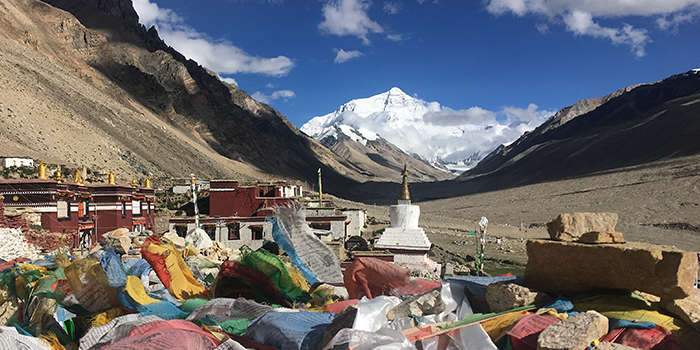
This tour also provides a side trip to Dujiangyan and Mt. Qingcheng in Chengdu before heading to Tibet.
Top 7. Discover the Sacred Beauty of Daocheng Yading
Daocheng Yading, often called ‘the Last Shangri-La’, is a pristine natural wonder in southwestern Sichuan. Surrounded by towering snow-capped mountains, sacred lakes, and untouched meadows, Daocheng is a place of profound beauty and spiritual significance. The area is perfect for trekking, photography, and connecting with nature’s tranquility. A classic Sichuan to Tibet overland tour with Daocheng Yading takes around two weeks via the G318 National Highway.
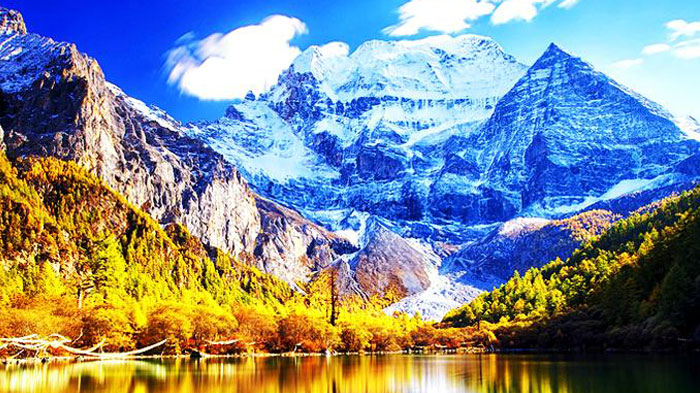 Explore the Daocheng Yading Nature Reserve during a Sichuan to Tibet overland tour.
Pay Attention to the Altitude Changes from Sichuan to Tibet
The altitude difference between the two regions is significant. Chengdu, the provincial capital of Sichuan Province, is just around 500 meters above sea level, while Lhasa sits at 3,650 meters. If you fly to Tibet from Chengdu, the rapid altitude changes can cause altitude sickness. It may reduce the risk by traveling from Sichuan to Tibet by train or overland as the altitude rises gradually over several days. However, even with gradual ascent, altitude sickness is still a possibility once you arrive in Tibet.
No matter which way you choose to get to Tibet from Chengdu, it’s important to acclimatize slowly, drink plenty of water, and avoid overexertion when you arrive in Tibet.
Get Your Tibet Travel Permit In Advance Before Leaving Sichuan
Before heading to Tibet from Sichuan, you need to obtain the Tibet Travel Permit in advance. It is a must for all trips to Tibet, no matter whether you travel by air or by land. With a local office in Chengdu, we at Tibet Vista provide convenient services for you to get a Tibet Travel Permit in Chengdu.
Once you book your Tibet tour with us, simply provide scanned copies of your passport and Chinese Visa, and we will handle the rest for you. After your permit is issued, we will deliver it to your hotel or you can pick it up at our Chengdu office.

Join our small group tour to enjoy a hassle-free journey from Chengdu to Tibet.
More Insider Tips
Generally speaking, staying in Chengdu for 2 days is enough to visit the main attractions in the city, experience the leisurely life atmosphere of Chengdu, and taste the local food.
The climate difference between Sichuan and Tibet is obvious. The climate in the Sichuan Basin is mild and humid, especially in Chengdu, which is rainy all year round and has few sunny days. Tibet has a higher altitude and strong sunshine, especially Lhasa, which is known as the "City of Sunshine" with more than 3,000 hours of sunshine throughout the year. Therefore, in addition to preparing rain gear, you also need to bring sun protection products such as sunglasses, hats, and sunscreen.
Most tourists choose to enter Tibet from Lhasa. If you start from Sichuan and are worried about altitude sickness, it is also recommended to go to Nyingchi, which has a lower altitude, first, and then travel from Nyingchi to Lhasa. Especially in spring, you can also enjoy the beautiful Nyingchi Peach Blossom Festival, which is very charming.
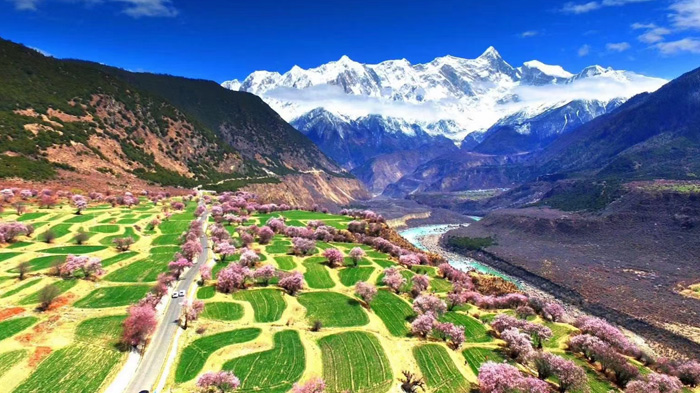 If you plan to travel to Tibet from Sichuan in the spring, consider visiting Nyingchi Peach Blossom Valley for its stunning views.
Conclusion
Traveling to Tibet from Sichuan is a popular route to Tibet, which covers two of the most stunning and historic areas of western China. These two adjacent regions have similarities and characteristics. Whether you love natural scenery or are interested in Tibetan culture, a Sichuan-Tibet trip can meet your needs.
Headquartered in Lhasa with a local office in Chengdu, we are ready to ensure a smooth and authentic travel experience in both Sichuan and Tibet. Contact us for your next Sichuan Tibet tour now!

Born in the Kham region and growing up in Lhasa, Lobsang Tsering has been credited by many travelers as a versatile, professional, and charismatic Tibetan guide. He is also one of the most experienced Tibetan guides in our big family.
Nowadays, Lobsang has dedicated himself to creating bite-sized Tibet travel videos and writing insightful travel articles for global travelers planning to visit Tibet.
 Email me about your travel idea
Related Articles & Posts
-
Lhasa - Gyantse - Shigatse - Everest Base Camp - Shigatse - Lhasa
USD949
View Details -
Lhasa - Gyantse - Shigatse - E.B.C - Saga - Kailash Trek - Darchen - Lake Manasarovar - Saga - Gyirong - Tingri - Lhasa
USD2069
View Details -
10 Days Lhasa to Everest Base Camp, Namtso Lake and Holy Elephant Gate Small Group Tour
Lhasa - Gyantse - Shigatse - EBC - Shigatse - North Tibet Grassland - Bange - Namtso Lake - Holy Elephant Gate - Lhasa
USD1299
View Details -
8 Days Driving Across Himalaya Overland Adventure from Kathmandu to Lhasa
Kathmandu - Gyirong - Everest Base Camp - Tingri - Shigatse - Gyantse - Lhasa
USD1019
View Details -
4 Days Lhasa Impression Small Group Tour: Explore the Heart of Tibet and Mingle with the Locals
Lhasa
USD509
View Details -
Lhasa - Gyantse - Shigatse - Everest Base Camp - Gyirong - Kathmandu
USD989
View Details -
Lhasa - Gyantse - Shigatse- Lhasa
USD799
View Details -
Lhasa - Gyantse - Shigatse - EBC - Saga - Darchen - Kailash Trek - Darchen - Saga - Gyirong - Kathmandu
USD2069
View Details
0 Comment ON "Sichuan Tibet Tour: How to Plan the Perfect Trip from Sichuan to Tibet"

