
 Search
.jpg "Tibetan Local Travel Agency")


Mount Kailash Trekking Experience: How is the Mt.Kailash Trek?
Trekking around Mt. Kailash is both a physically challenging and spiritually uplifting experience. The thin air and rugged terrain will test your endurance, but every step rewards you with stunning Mt. Kailash views and a deep connection to this sacred land.
Besides, with improved supply points and accommodations along the route, every traveler can now experience this ultimate Himalayan pilgrimage with better comfort and peace of mind.
So, in this travel guide, we will walk you through the day-to-day Mt. Kailash trekking experience, highlight the most physically challenging part, and share insider tips to help you enjoy a safe and smooth adventure to this sacred peak.
Content
Is lt Hard to Trek Mount Kailash? Can I Do This Trek?
How Is the First-Day Trekking Experience of the Mt. Kailash?
How Is the Second-Day Trekking Experience of the Mt.Kailash?
How Is the Third-Day Trekking Experience of the Mt.Kailash?
How Is the Trekking Experience of Touching the Mt.Kailash?
Is lt Hard to Trek Mount Kailash? Can I Do This Trek?
Yes, of all the trekking routes in Tibet, the Mt. Kailash trek is the most difficult, physically.
The entire Mt. Kailash trek spans 52km (32miles) around the outer perimeter of Mt. Kailash, and for most travelers, it takes 3 days and 2 nights to finish the entire arduous walk, with an average altitude of around 4,700m.
The hardest part unfolds when you cross the Dolma La Pass (5,630m) on the second day, which is the highest point of the 3-day trek. Apart from the thin air and the high altitude, parts of the trail are filled with loose rocks underfoot. This is why the Mount Kailash trek is widely believed to be a true test of your body and spirit.
However, no worries! Most travelers with an average fitness level can complete the trek as long as you prepare well, acclimatize properly, walk at your own pace, and most importantly, have our local experts by your side.
Along the way, you will meet the devoted Tibetan pilgrims prostrating themselves on rocky trails and travelers from around the world. Their unyielding spirits and great devotion will inspire you to keep going until you reach the finish line. Learn if there is an age limit for the Mt. Kailash trek.
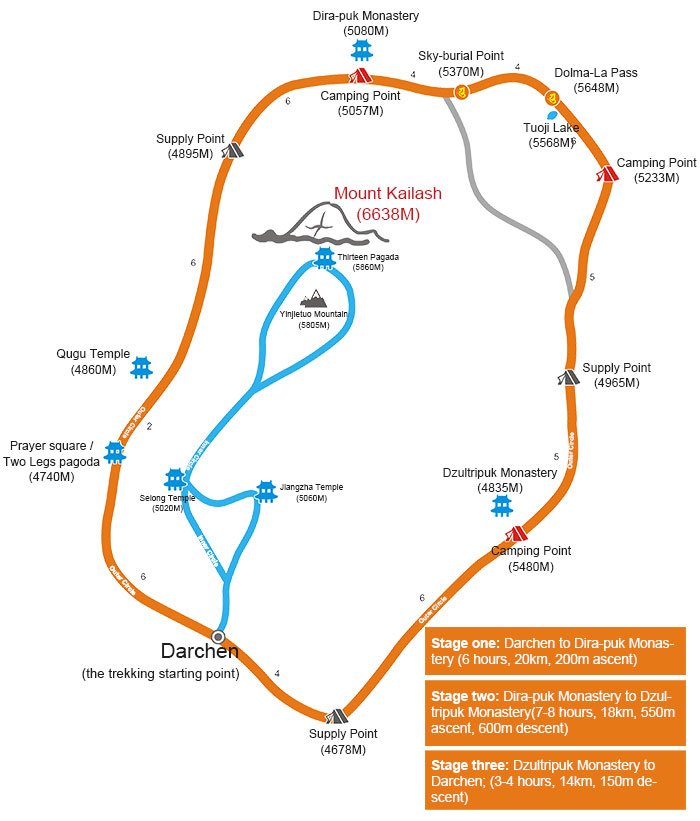 The classic 3-day Mt. Kailash trek on the map.
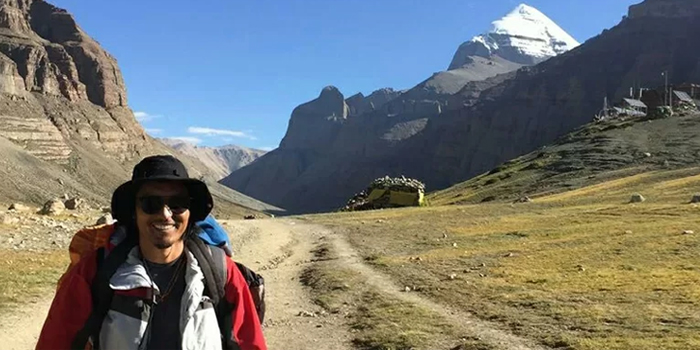

Enjoy the classic 15-day Lhasa to Mt. Kailash and Lake Manasarovar tour to explore the magical power of Tibet's holiest peak.
How Is the First-Day Trekking Experience of the Mt. Kailash?
The first day of the Mt. Kailash trek starts from Darchen (4,675m) to Dirapuk Monastery (5,050m). It covers around 20km and takes about 6 to 7 hrs to reach the first lodging place (Dirapuk Monastery), where you will be rewarded with the stunning pyramid-shaped north face of the sacred Mt. Kailash.
It will be a long walk but relatively easy. So, you can take your first day’s trek as a warm-up to get used to the high-altitude trek around the holy Mt. Kailash.
After checking your entrance tickets, all the guests will board the eco-bus for the initial 6km bus ride from Darchen to the Prayer Flag Square. Here, you can see colorful Tibetan prayer flags fluttering against the deep blue sky, and the south face of the Mt Kailash looms in the distance.
If you happen to visit here during the Saga Dawa Festival (Late May or early June), you can join the massive Tibetan pilgrims to see the gigantic prayer flag pole (Tarboche) being raised each year to honor Shakyamuni’s birth, enlightenment, and entry into nirvana and experience other century-old Buddhist traditions like tossing white and auspicious Tsampa (barley flour), hanging Tibetan prayer flags, and more.
Experience the vibrant festivities and fervent Mt. Kailash pilgrimage during the traditional Saga Dawa Festival.
From the Prayer Flag Square, you can walk across the iconic two-legged stupa’s archway to officially begin your Mt. Kailash trek. Locals believe that by doing so, it can help you remove the bad karma and bring blessings for your smooth Mt. Kailash kora.
As you follow the well-trodden trails to the broad river valley (Lha Chu), the holy Mt. Kailash slowly comes into view and grows closer and more imposing with each passing mile. Along the way, you can see many mani stones (piles of carved stones with mantras), prayer flags, and ruins of stupas left by generations of Tibetan pilgrims.
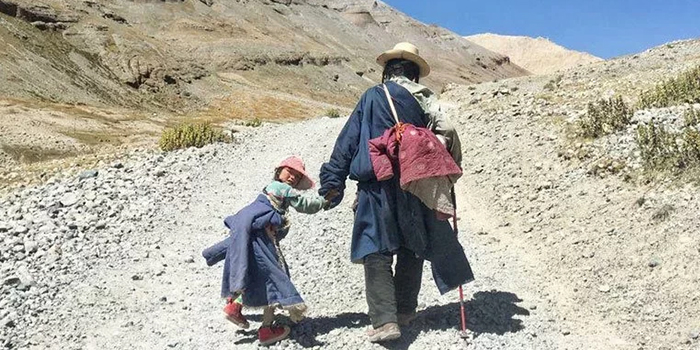
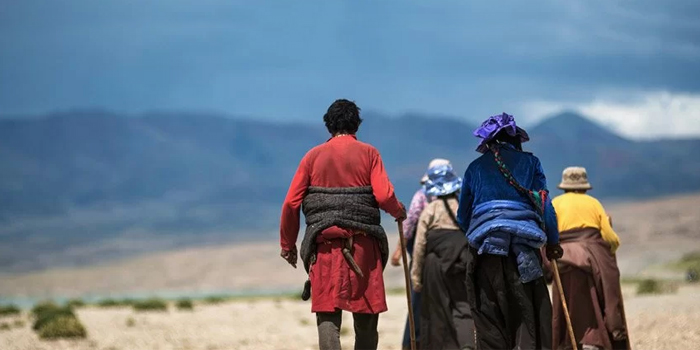
Besides, you will be walking past pious Tibetan pilgrims, young and old, who are either making full-body prostration along rugged trails or walking in great reverence while spinning Tibetan prayer wheels and chanting mantras. Their determination and great devotion to the Buddha will touch your heart and inspire you to see our life in a whole new way.
On the first day of the trek, there are 3 supply points available where you can have a rest and enjoy simple meals, such as Tibetan butter tea, instant noodles, tomato egg stir-fry, and more.
By late afternoon, you will reach Dirapuk Monastery, your first overnight stop, where the breathtaking pyramid-shaped north face of Mount Kailash rises majestically before you. It is the moment that you can pray and truly feel the divine power of sacred Mount Kailash. Read the ultimate guide to how to plan a Mount Kailash trek.
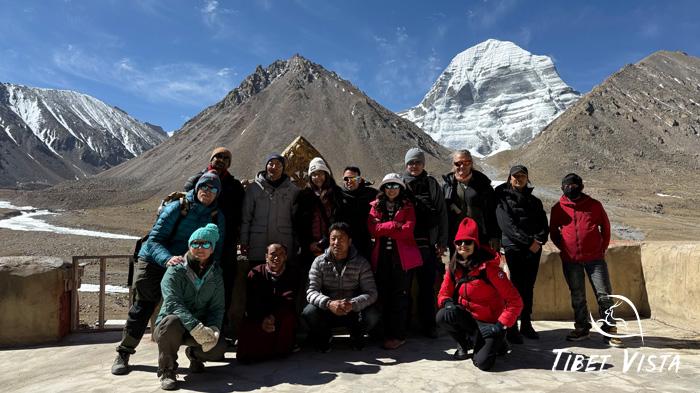 Our guests took photos with the north face of the holy Mount Kailash during the Mt. Kailash trek.
Explore holy Mt. Kailash and Lake Manasarovar from Lhasa and further journey to Kathmandu with our smooth border transfer service.
How Is the Second-Day Trekking Experience of the Mt.Kailash?
Today marks the most challenging and magical part of the Mt. Kailash trek. You will walk from Dirapuk Monastery (5,050 m) to Zuthulpuk Monastery (4,790 m) by crossing Dolma-la Pass (5,630m), the highest point of the 3-day Mt. Kailash trek. The entire trek covers about 24 km, with roughly 600m of ascent followed by around 900m of steep descent on rocky slopes.
Have an early rise to enjoy the dramatic view of Mt. Kailash bathed in soft, golden morning sunlight. Then, you may join the local pilgrims on the stony kora (pilgrimage) path to begin the slow ascent to the Dolma-la Pass hidden above the imposing Drolma-chu Valley.
The trail quickly becomes steep, and the altitude rises steadily. You can see that the grassy terrain gradually gives way to bare rocks and patches of snow. After about an hour of walking, you will reach a small platform (Jarok Donkhang) where sky burial, a unique Tibetan funeral practice, is performed. From here, you can see the majestic north face of Mt. Kailash rising like a giant pyramid with a palpable sense of holiness.
As you move higher, you will pass a sacred rocky area (called Shiva-tsal). For Tibetans, this is one of the most sacred spots of the entire Mt. Kailash kora. It is here that Tibetan pilgrims will symbolically go through a “death and rebirth” ritual. They will leave behind old clothes, a strand of hair, or even a drop of blood here as a way of letting go of their past life, mistakes, and worldly attachments. After crossing Dolma-la Pass, it is believed they are “reborn”, beginning a new and purified life.
After about 2 hours of tough climbing, you will finally reach Dolma-la Pass (5,630 m), the highest point of the Mt. Kailash trek. Surrounded by jagged, snow-capped peaks, you can proudly say, “I’ve made it to the top!” and now you have been reborn, and, by the mercy and compassion of Drolma, all the past mistakes and negative karma are believed to be purified.
Besides, you may join Tibetan pilgrims to hang auspicious Tibetan prayer flags at the mountain pass, toss colorful Longda (prayer papers) into the sky, or paste money or a photo of a loved one who has passed away on the iconic Dolma-la rock for blessings.
From Dolma-la, you will follow the steep and rocky trail for the descent. This downhill part can be tougher on the knees than the climb itself, so please use your trekking poles for balance and walk slowly and carefully.
Besides, as you walk down to the western side of Mt. Kailash, don’t miss out on admiring the Lake of Compassion (Gauri Kund, 5,608m), a small turquoise holy lake in Hindu mythology. After about 3 hours of steady trekking downhill, you will safely arrive at Zuthulpuk Monastery (4,790 m), your overnight place for the second day of the trek.
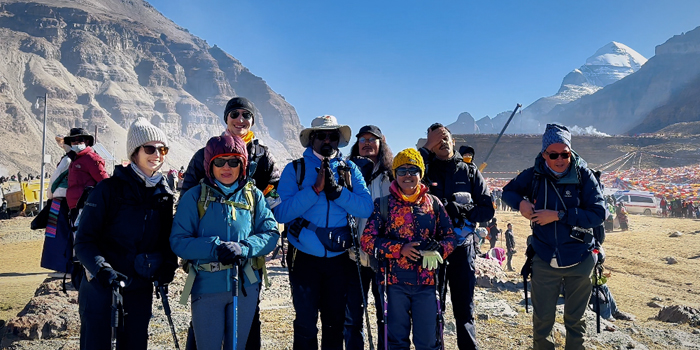
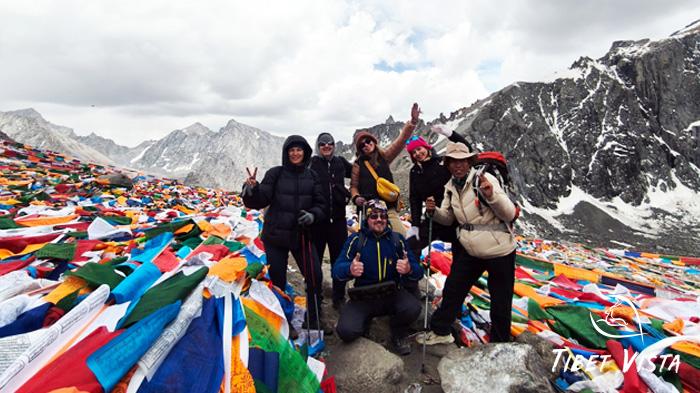 Our guests and local Tibetan guide took pictures at Dolma-la Pass.
Travel overland from Kathmandu to sacred Mt. Kailash with our smooth border transfer service.
How Is the Third-Day Trekking Experience of the Mt.Kailash?
The last day’s trek from Zuthulpuk Monastery (4,790 m) to Darchen (4,675m) is the easiest and most relaxing. You may use this last 14-km walk (around 3 hours) to reflect on the spiritual odyssey you are about to complete and enjoy the enchanting downhill walk back to Darchen with a great sense of accomplishment.
The final part of the pilgrimage trail passes through green meadows and clear streams, with fresh, open valley scenery along the way. As you walk, you might even spot some lovely marmots (chubby ground squirrels in the Himalayan regions) along the way!
To allow our guests to enjoy the full Mt. Kailash kora experience, after you reach Darchen, you can enjoy our smooth bus transfer to the sacred Lake Manasarovar, 41km southeast of Mt. Kailash.
Here, you can stroll along the holy lake to enjoy the amazing view of the Mt. Kailash reflected on shimmering Lake Manasarovar, purify your soul with the sacred water, perform a holy ritual, or meditate at the lakeshore to connect your soul with the holy Mt. Kailash. You may take your time to breathe deeply and embrace the holy vibes and divine presence, without feeling rushed.
Another hidden bonus is that you can enjoy the hot spring around the nearby monastery to smooth the tired muscles of your feet after the arduous Mt. Kailash trek.
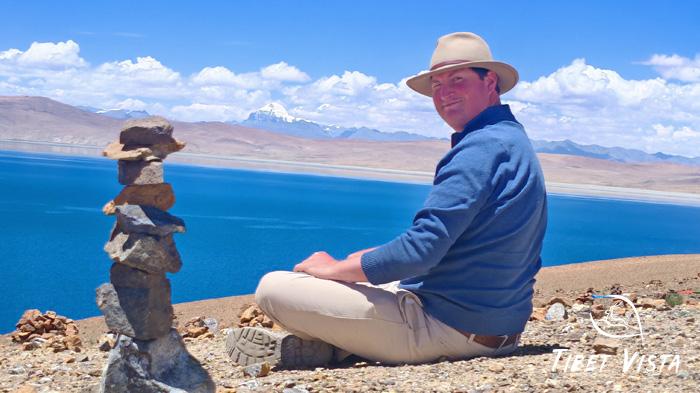 Our guests took pictures with the holy Lake Manasarovar.
Enjoy the classic 15-day Lhasa to Mt. Kailash and Lake Manasarovar tour to explore the magical power of Tibet's holiest peak.
How Is the Trekking Experience of Touching the Mt.Kailash?
Only a handful of our guests were extremely lucky to physically touch the rockface of the holy Mt. Kailash and pray to the Buddhist deities. In 2024, we helped around 196 guests successfully touch the facade of the north face of Mt. Kailash during their 3-day Mt.Kailash kora (pilgrimage).
However, out of deep respect for this sacred mountain and to ensure travelers’ safety from occasional falling rocks, currently, no one is allowed to touch Mt. Kailash, as mandated by the local government.
While you can’t physically touch Mount Kailash, during your Mt. Kailash trek, our local experts will lead you to the closest viewpoints along the trek, where you can pause, meditate, and feel the omnipresence of God near the holy mountain. Many of our guests say that they can feel the divine power and truly reach out and touch their hearts.
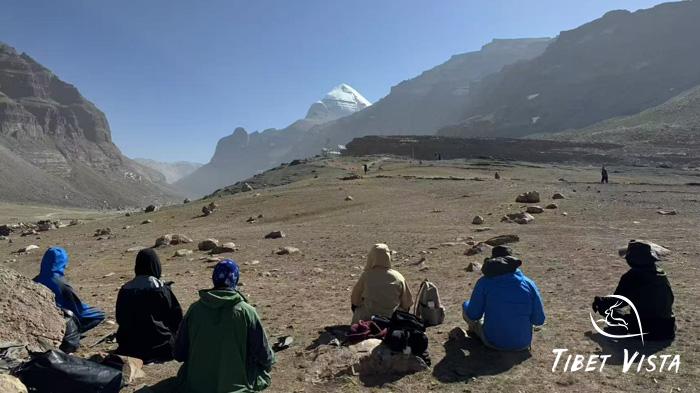 Our guests closely meditate before the sacred Mt. Kailash during their Mt. Kailash kora.
Experience the vibrant festivities and fervent Mt. Kailash pilgrimage during the traditional Saga Dawa Festival.
How Is the Inner Mt.Kailash Trekking Experience?
The Mount Kailash inner trek is far more challenging and treacherous than the classic 3-day Mt. Kailash outer trek. It is a day trek that covers around 34 km with an average altitude of over 5,000 meters, and its highest mountain pass reaches 5,860 meters. In fact, local Tibetans believe that after you have completed 13 outer kora of Mt. Kailash, you are eligible for the Kailash inner kora (pilgrimage).
To experience the Mt. Kailash inner trek, you will embark on the trek from Darchen and follow the rugged trails filled with loose rocks to circumambulate the mysterious Mt. Nandi (or Mt. Yinjietuo), a holy guardian of Mt. Kailash to its south, in just one day. The reward you get is the incredible, up-close view of the south face of the sacred Mt. Kailash.
The hardest part of Mt. Kailash inner treks comes when you have to rely on ropes and Tibetan prayer flags hanging on the Mt. Kailash rockface to climb to 13 Golden Chortens (5,860m) and Saptarishi Cave, a natural patio embedded in the cliff of Mt. Kailash. And later, climb over Mt. Nandi Pass (5,805m) to descend to the right side of the valley and make your way back to Darchen.
Since there are no supply points, phone signals, or medical support, and fewer pilgrims are seen along the way, the Mt. Kailash inner trek is the toughest journey, best suited for the fittest and well-prepared pilgrims and travelers.
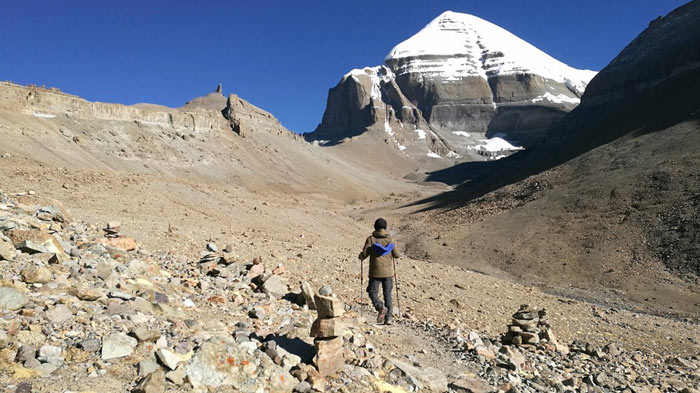 Our guests walk on the loose rock to get closer to the south face of Mt. Kailash in the inner kora.
Conclusion
Physically challenging, but visually stunning and spiritually uplifting, the Mt. Kailash trek is truly a spiritual odyssey like no other on the Roof of the World. Whether you come to experience Tibet’s ultimate pilgrimage trek or are keen to meditate and feel the divine power of sacred Mount Kailash to cleanse bad karma and purify your soul, you will enjoy an adventure of a lifetime with our attentive local experts by your side.
If you have more questions about the Mt. Kailash tour, don’t hesitate to email us for free and expert travel solutions. Looking forward to exploring the magic of the holy Mt. Kailash with you in Tibet soon. Tashi Delek!

With 20+ years of guide experience and tons of great reviews, Sonam Tenphel is one of the top-rated local Tibetan guides in our team. Polite, enthusiastic, and extremely attentive to every traveler’s needs, he is your best travel companion in Tibet and a walking dictionary of Tibetan culture and history.
Additionally, being a great photographer, Sonam helps you capture great Tibet travel moments and maximize your Tibet experiences like no other.
 Email me about your travel idea
Related Articles & Posts

Most Popular Tibet Tour Packages
-
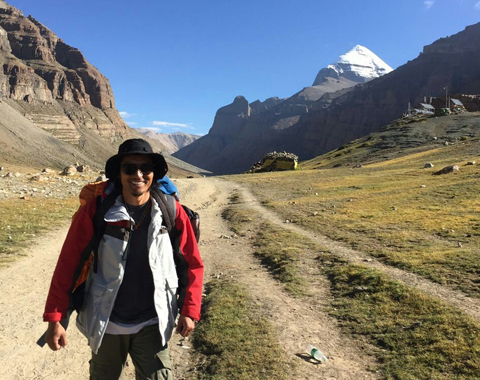
Lhasa - Gyantse - Shigatse - E.B.C - Saga - Kailash Trek - Darchen - Lake Manasarovar - Saga - Gyirong - Tingri - Lhasa
USD2069
View Details -
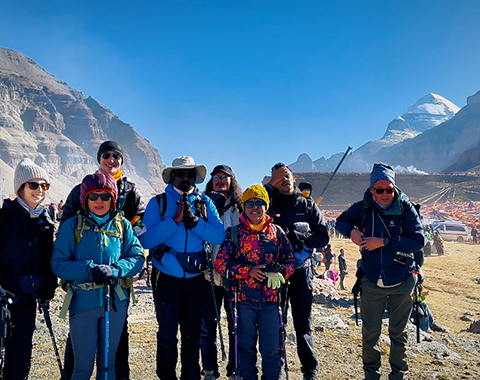
Lhasa - Gyantse - Shigatse - EBC - Saga - Darchen - Kailash Trek - Darchen - Saga - Gyirong - Tingri - Lhasa
USD2219
View Details -
10 Days Kailash Pilgrimage Tour from Kathmandu, via Gyirong Port
Kathmandu - Gyirong - Saga - Mt.Kailash - Lake Manasarovar - Darchen - Saga - Gyirong - Kathmandu
USD1749
View Details -
Lhasa - Gyantse - Shigatse - EBC - Saga - Darchen - Kailash Trek - Darchen - Saga - Gyirong - Kathmandu
USD2069
View Details -
17 Days Kailash Manasarovar Full Moon Tour & Guge Kingdom Exploration
Lhasa - Gyantse - Shigatse - EBC - Saga - Darchen - Zanda - Kailash Trek - Darchen - Saga - Gyirong - Tingri - Lhasa
USD2299
View Details -
Lhasa - Gyantse - Shigatse - Everest Base Camp - Shigatse - Lhasa
USD949
View Details -
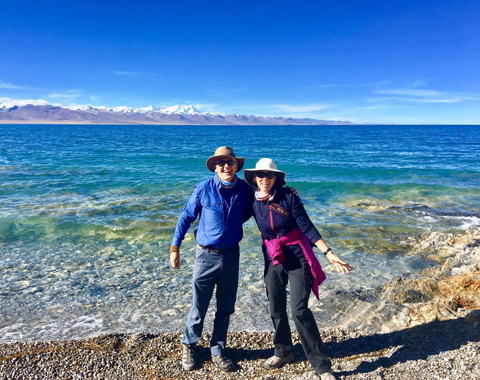
10 Days Lhasa to Everest Base Camp, Namtso Lake and Holy Elephant Gate Small Group Tour
Lhasa - Gyantse - Shigatse - EBC - Shigatse - North Tibet Grassland - Bange - Namtso Lake - Holy Elephant Gate - Lhasa
USD1299
View Details -
8 Days Driving Across Himalaya Overland Adventure from Kathmandu to Lhasa
Kathmandu - Gyirong - Everest Base Camp - Tingri - Shigatse - Gyantse - Lhasa
USD1019
View Details -
4 Days Lhasa Impression Small Group Tour: Explore the Heart of Tibet and Mingle with the Locals
Lhasa
USD509
View Details -
Lhasa - Gyantse - Shigatse - Everest Base Camp - Gyirong - Kathmandu
USD989
View Details -
Lhasa - Gyantse - Shigatse- Lhasa
USD799
View Details
0 Comment ON "Mount Kailash Trekking Experience: How is the Mt.Kailash Trek?"


Is lt Hard to Trek Mount Kailash? Can I Do This Trek?
How Is the First-Day Trekking Experience of the Mt. Kailash?
How Is the Second-Day Trekking Experience of the Mt.Kailash?
How Is the Third-Day Trekking Experience of the Mt.Kailash?
How Is the Trekking Experience of Touching the Mt.Kailash?