
 Search
.jpg "Tibetan Local Travel Agency")


Jokhang Temple History: Legends and History of the Holiest Temple in Lhasa
Located about 1,000 meters east of the Potala Palace, the Jokhang Temple is the oldest and holiest site in Lhasa. As the spiritual center of Tibet and the ultimate pilgrimage destination, it continues to draw countless pilgrims and travelers who come to worship and walk its kora.
As the most outstanding surviving architecture from the Tubo Period (618–842 AD), Jokhang Temple has been rebuilt and enlarged several times before taking the shape we see today. Even the name of Lhasa city has been deeply influenced by this sacred temple.
While its 1,400 years of history cannot be fully told in a single article, here we share the key stories, legends, facts, and tips to help you gain deeper insight into the spiritual heart of Tibet.
Content
History of Jokhang Temple: Closely Linked to the Two Princesses Married to the Tubo King
Legends of Jokhang Temple: Three Stories that Reveal Different Sides of the Temple
Facts of Jokhang Temple: Its Significant Influence on Lhasa and the Miracle during the Fire
How to Explore Jokhang Temple: Walk the Kora, Meet Pilgrims, and See Relics Inside
Tips for Visit Jokhang Temple: Don’t Miss the Celebration during Tibetan Festivals
History of Jokhang Temple: Closely Linked to the Two Princesses Married to the Tubo King
Also known in Tibetan as the Tsuglhakhang, the Jokhang Temple is the most revered religious site in Tibet. It was built in 652 by King Srongtsen Gampo of the Tubo dynasty to honor his marriage to Princess Bhrikuti of Nepal. As part of her dowry, she brought a statue of the eight-year-old Akshobhya Buddha, which is now enshrined in Lhasa’s Ramoche Temple.
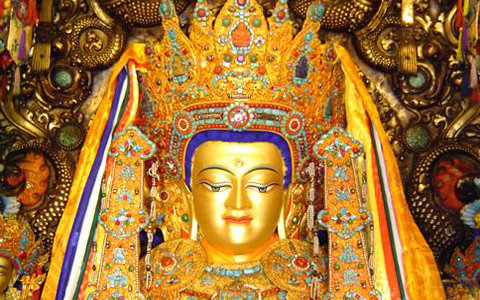
Later, to establish peaceful relations with Emperor Taizong of the Tang dynasty, Srongtsen Gampo married his daughter, Princess Wencheng, as his second wife. When Wencheng traveled to Tibet, she brought with her a life-size statue of the 12-year-old Jowo Sakyamuni, the founder of Buddhism, which became the most treasured statue in the Jokhang Temple.
From 755 to 797, during the reign of King Tresang Detsan, Buddhists faced persecution due to the king’s minister’s hostility toward the religion. Monks at the Jokhang Temple were also targeted. Later, in the anti-Buddhist campaigns of the late ninth and early tenth centuries, both Jokhang and Ramoche Temples were reportedly used as stables.
As one of the surviving Tubo-era structures in Tibet, the Jokhang Temple is considered the first civil building of Tibetan architecture. Its design reflects the combined influences of Tibetan, Tang Dynasty Chinese, Nepalese, and Indian architects and craftsmen.
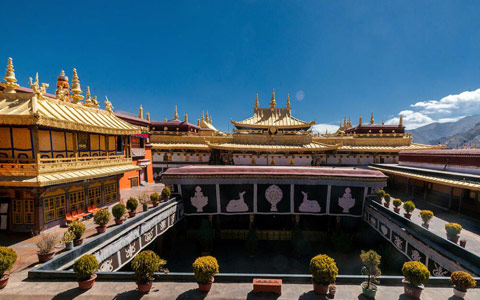
After undergoing several reconstructions during the Yuan, Ming, and Qing dynasties, the Jokhang Temple has grown into a vast complex with three floors and an open roof, filled with chapels and chambers. Covering more than 25,000 square meters in the heart of Lhasa, it remains one of the must-see attractions during a Lhasa tour.
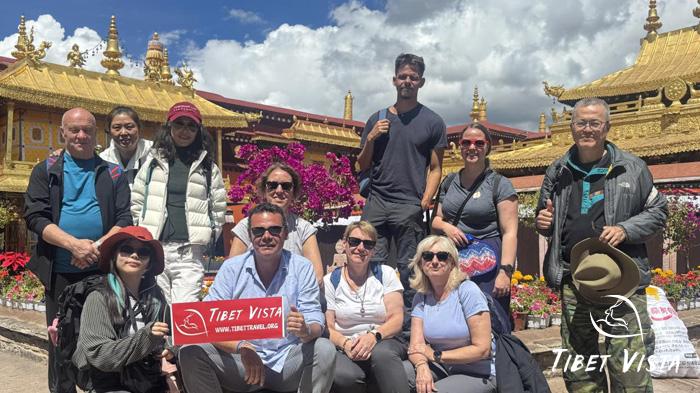 Our beloved guests take group pictures on the second floor of Jokhang temple.

Join our classic 4-day Lhasa tour to explore the essence of Lhasa with Jokhang temple.
Legends of Jokhang Temple: Three Stories that Reveal Different Sides of the Temple
The saying ‘Jokhang Temple stood here before Lhasa was established’ is widely known among Tibetans, highlighting the temple’s special significance. In fact, many legends are connected to the origins of both the Jokhang Temple and the city of Lhasa.
It’s said that to find a location for the temple, the king tossed his ring (a hat in another version) ahead of him with a promise to build a temple where the ring landed. Unexpectedly, the ring fell into a lake where a white stupa suddenly emerged. Thus the king used thousands of rams packing sand and soil to fill the lake and built a temple over it.
In another version of the legend, Queen Bhrikuti founded the temple to install the statue she had brought and Wencheng selected the site according to Chinese geomancy and Feng Shui (also geomantic omen).The lake was filled, leaving a small pond now visible as a well fed by the ancient lake, and a temple was built on the filled area.
The most widely known version links Jokhang Temple’s construction to Princess Wencheng. When the Tubo rulers moved the capital to Lhasa, frequent floods made settlement difficult. Skilled in astrology and divination, Wencheng observed that the Qinghai-Tibet Plateau resembled a lying devil, with Wutang Lake at its “heart.”
To counteract evil forces, she advised building a grand temple on the lake. Songtsen Gampo followed her advice, and using sand and soil carried by rams, the lake was filled to create the temple’s foundation. After the temple was built, the floods were brought under control.
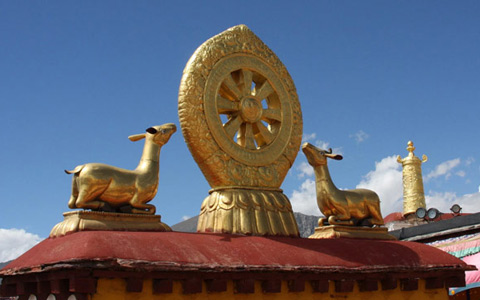
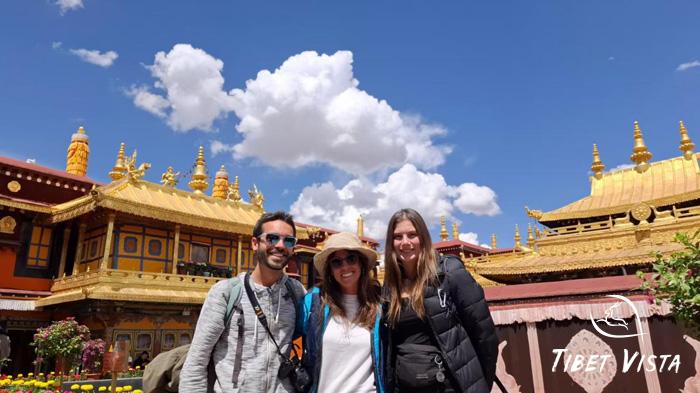 The golden summit of Jokhang temple, the spiritual heart of Tibet.
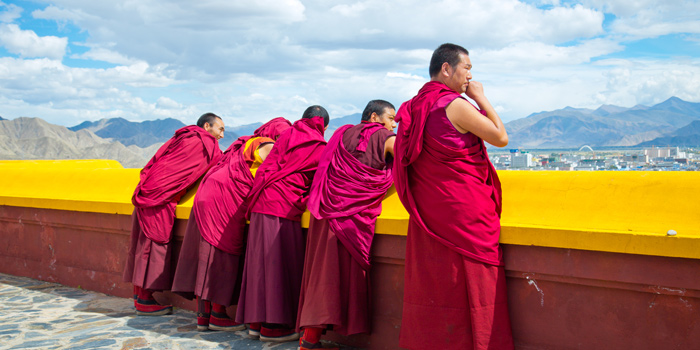
To dive deeper into Tibetan religion and tradition, you can extend your Lhasa tour to Shigatse with our 6-day Central Tibet Culture Tour.
Facts of Jokhang Temple: Its Significant Influence on Lhasa and the Miracle during the Fire
In fact, the name “Lhasa” evolved from Jokhang Temple. Originally, Lhasa was called “Rasa”: “Ra” means ram, and “Sa” means land, together referring to land built by rams.
Later, after the temple was built to house holy Buddha statues and chapels, it was renamed Jokhang, meaning “House of Buddha.” The city itself became known as Lhasa: “Lha” means Buddha, and “Sa” means land, together representing the land of Buddha.
This is the origin of Lhasa’s name. Even today, rams are worshiped by Tibetans, a unique custom reflecting their deep connection with these animals. Also, when you visit Lhasa, you’ll notice that near Jokhang Temple, no building is taller than the temple, reflecting the Tibetans’ respect for this sacred site.
On February 17, 2018, the Jokhang Temple in Lhasa caught fire just before sunset. Fortunately, the fire was quickly extinguished, with no deaths or injuries. Even more miraculously, no cultural relics were damaged. Many people believed this was a manifestation of the divine.
 The architecture of Jokhang Temple is a blend of Tang Dynasty, Tibetan, and Nepali styles, making it a perfect spot for photography.
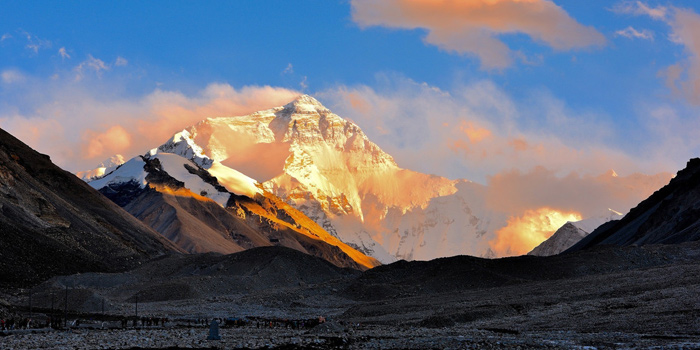
Join our classic 8-day Lhasa to Everest Base Camp tour to admire the Himalayas with unforgettable cultural highlights.
How to Explore Jokhang Temple: Walk the Kora, Meet Pilgrims, and See Relics Inside
To get the best of Jokhang temple from all dimensions, it is suggested to Explore from the outside to inside, and take your time to see the most authentic devotions.
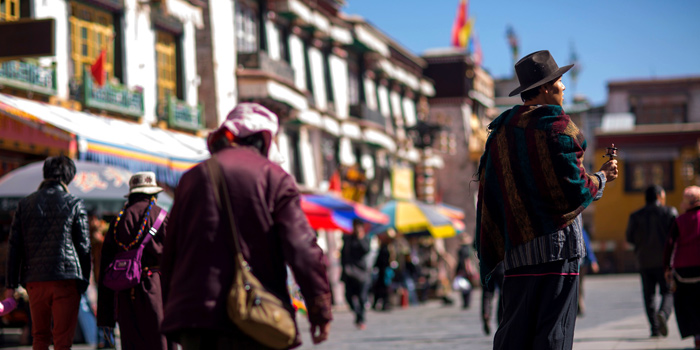
First, walk the Barkhor Kora. This is the one of the most popular Kora you can join in Tibet, circling the Jokhang Temple. The best time to experience it is in the morning, between 9 and 10 am, when local Tibetans follow their daily routine of circumambulation. As you walk clockwise, you will see pilgrims spinning prayer wheels, chanting mantras, and performing prostrations.
Second, pause at the front gate. This area gathers large numbers of local pilgrims performing their rituals. Join them for a while to witness the devotion, peace, and sincerity of Tibetan worship. If you want to take pictures, it’s recommended to avoid close-up shots so as not to disturb their rituals.
Third, explore the treasures inside. Once inside, you will discover the cultural and historical richness of Jokhang Temple. Highlights include the unique Tubo-era architectural structure, the priceless life-sized statue of Sakyamuni Buddha, exquisite wood carvings, colorful murals, and numerous precious relics.
Finally, don’t miss the Kora on the second floor. Though it is the shortest Kora in the temple and takes only about five minutes to complete, it holds immense significance for Tibetans. Being closest to the Buddha, this elevated circumambulation is considered especially sacred, allowing you to experience a quiet, personal connection with the spiritual heart of Jokhang Temple.
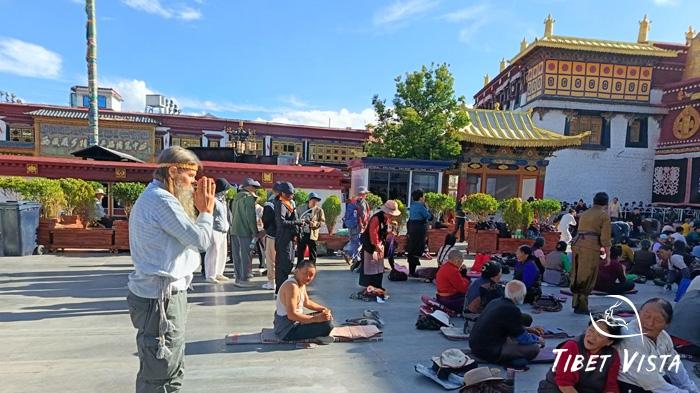 Our guests, many of whom are devoted Buddhists, make a pilgrimage to Jokhang Temple.
Tips for Visit Jokhang Temple: Don’t Miss the Celebration during Tibetan Festivals
If you visit during the Tibetan New Year (February 18, 2026), you’ll be fortunate enough to join the celebrations at Jokhang Temple. Crowds in traditional Tibetan costumes come to the temple to worship, and thousands of monks perform colorful religious rituals in and around the temple. You will be swept up in the joy and festive atmosphere that fills the air.
Similarly, the Tsongkhapa Butter Lamp Festival brings a vibrant festive vibe to Jokhang Temple. It is held on the 25th day of the 10th month of the Tibetan calendar, which falls on December 14, 2025. At the temple during the festival, starting at 8 p.m., thousands of pilgrims perform the kora around the temple, accompanied by the soft murmur of prayers echoing along Barkhor Street.
Winter is a great time to visit Jokhang Temple, as it coincides with the season when local pilgrims gather. After the autumn harvest, Tibetans come to Lhasa during winter to perform their pilgrimages. As the holiest site in Tibet, Jokhang sees its highest number of local visitors during this season, offering travelers an authentic experience of Tibetan devotion and daily life.
Regarding opening hours, the temple is open from 8:30 a.m. to 6:30 p.m., with the morning hours being the best time to witness local pilgrims in action. It’s advisable to arrive around 8 a.m. to watch their devotions before exploring the interior. Once inside, walk clockwise from left to right. Spending 1 to 2 hours is ideal to fully explore the temple and its cultural treasures.
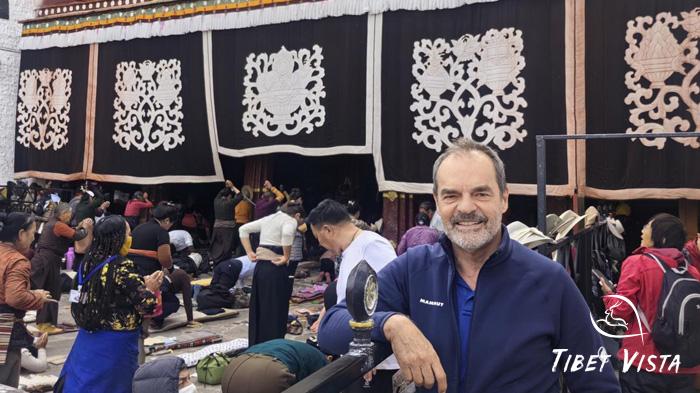 When taking photos near Jokhang temple, please be mindful not to disturb the pilgrims.
Conclusion
Jokhang Temple is the heart of Tibet and a place full of history and legends. Its ancient architecture and priceless Buddha statues draw pilgrims and travelers alike. Walking the Kora, seeing devotees pray, and joining in festivals like Tibetan New Year or the Butter Lamp Festival makes the temple come alive.
Visiting Jokhang is not just sightseeing; it’s a chance to feel the faith and culture of Tibet. If you have any questions about Jokhang Temple or Tibet tour, don’t hesitate to contact us for answers.
With 20+ years of guide experience and tons of great reviews, Sonam Tenphel is one of the top-rated local Tibetan guides in our team. Polite, enthusiastic, and extremely attentive to every traveler’s needs, he is your best travel companion in Tibet and a walking dictionary of Tibetan culture and history.
Additionally, being a great photographer, Sonam helps you capture great Tibet travel moments and maximize your Tibet experiences like no other.
 Email me about your travel idea
Related Articles & Posts
Most Popular Tibet Tour Packages
-
Lhasa - Gyantse - Shigatse - Everest Base Camp - Shigatse - Lhasa
USD949
View Details -
Lhasa - Gyantse - Shigatse - E.B.C - Saga - Kailash Trek - Darchen - Lake Manasarovar - Saga - Gyirong - Tingri - Lhasa
USD2069
View Details -
10 Days Lhasa to Everest Base Camp, Namtso Lake and Holy Elephant Gate Small Group Tour
Lhasa - Gyantse - Shigatse - EBC - Shigatse - North Tibet Grassland - Bange - Namtso Lake - Holy Elephant Gate - Lhasa
USD1299
View Details -
8 Days Driving Across Himalaya Overland Adventure from Kathmandu to Lhasa
Kathmandu - Gyirong - Everest Base Camp - Tingri - Shigatse - Gyantse - Lhasa
USD1019
View Details -
4 Days Lhasa Impression Small Group Tour: Explore the Heart of Tibet and Mingle with the Locals
Lhasa
USD509
View Details -
Lhasa - Gyantse - Shigatse - Everest Base Camp - Gyirong - Kathmandu
USD989
View Details -
Lhasa - Gyantse - Shigatse- Lhasa
USD799
View Details -
Lhasa - Gyantse - Shigatse - EBC - Saga - Darchen - Kailash Trek - Darchen - Saga - Gyirong - Kathmandu
USD2069
View Details
0 Comment ON "Jokhang Temple History: Legends and History of the Holiest Temple in Lhasa"


History of Jokhang Temple: Closely Linked to the Two Princesses Married to the Tubo King
Legends of Jokhang Temple: Three Stories that Reveal Different Sides of the Temple
Facts of Jokhang Temple: Its Significant Influence on Lhasa and the Miracle during the Fire
How to Explore Jokhang Temple: Walk the Kora, Meet Pilgrims, and See Relics Inside
Tips for Visit Jokhang Temple: Don’t Miss the Celebration during Tibetan Festivals