
 Search
.jpg "Tibetan Local Travel Agency")



Explore the Lost Guge Kingdom: Travel Guide to Tibet’s Greatest Mystery
Once a powerful center of Tibetan art, religion, and culture, the Guge Kingdom stood proudly in the remote valley in the Ngari prefecture. Then, one day, it vanished without a trace, leaving behind silent ruins and uncovered mystery that still fascinate tourists.
The reason behind its sudden disappearance remains one of Tibet’s greatest mysteries. Yet, the majesty of the Guge Kingdom can still be seen through its remaining grand ancient palaces, colorful frescoes, and sacred stupas that have stood for nearly a thousand years.
In this travel guide, we uncover the geography and history of the Guge Kingdom, the mystery behind its fall, and the main highlights to explore. You’ll also find nearby attractions, and a suggested itinerary to help you uncover the story of Tibet’s most mysterious lost civilization.
Content
The Geographic Facts and History of the Guge Kingdom in Tibet
Why the Guge Kingdom Disappeared Overnight: A Mystery That Still Remains
What to Explore at the Guge Kingdom: The Grand Palace, Frescoes, and Stupas
Other Famous Attractions Near the Guge Kingdom and Recommended Itinerary
The Geographic Facts and History of the Guge Kingdom in Tibet
The Guge Kingdom site is sitting on a clay hill by the Xiangquan River in Zanda County, Ngari Prefecture. It covers about 18,000 square kilometers at an elevation of around 3,800 meters.
The site has over 300 cave homes, several stupas, four temples, two assembly halls, and two underground tunnels. The ruins are built in three levels: upper, middle, and lower. The upper level had the royal palace, the middle had the temples, and the lower had the residential areas.
The complex is set against the mountains and faces the river. Its location was chosen for defense and war strategy. This makes the layout of the Guge Kingdom very unique.
The history of Guge Kingdom started from the ancient Zhangzhung civilization. It appeared around the 9th century after the Tubo Empire, which once ruled Tibet, collapsed. The kingdom lasted until the 17th century and had sixteen kings.
It was founded by descendants of the Tubo royal family in western Tibet’s Ngari region. At its peak, the kingdom’s influence covered the whole Ngari area.
The Guge Kingdom did more than continue the Tubo royal line. It also revived Buddhism in Tibet after the Tubo Empire fell. This brought a new era of religious and cultural growth. Because of this, the Guge Kingdom is an important part of Tibetan history.
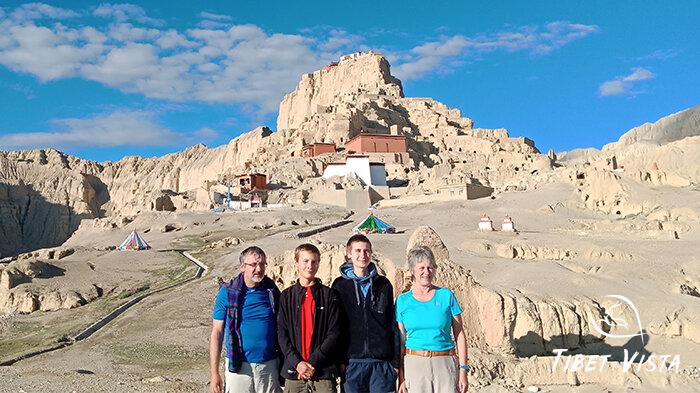
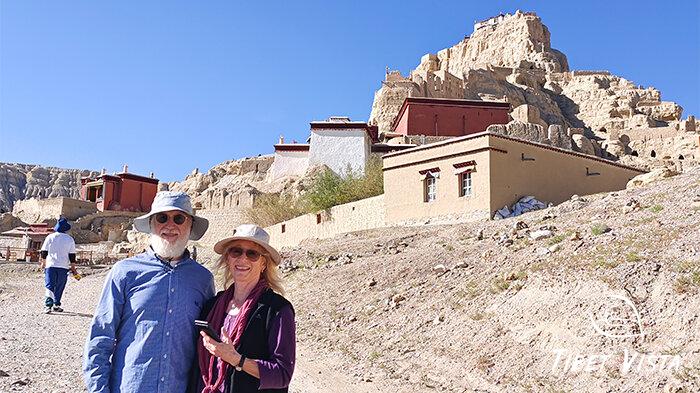 Our beloved guests take pictures in front of Guge kingdom ruins.
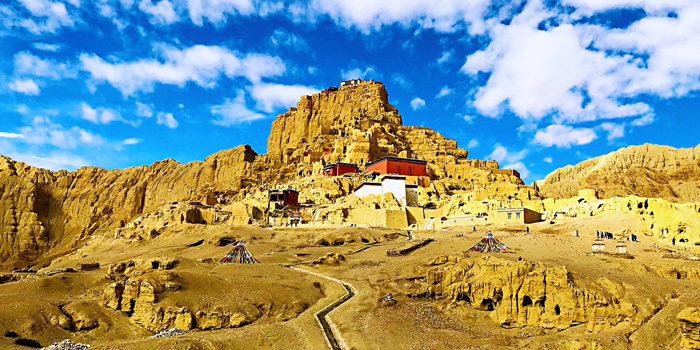

Join our classic 17 days Kailash and Guge Kingdom tour to explore the essence of Tibet.
Why the Guge Kingdom Disappeared Overnight: A Mystery That Still Remains
The sudden disappearance of the Guge Kingdom remains one of Tibet’s greatest mysteries. What caused its sudden fall? There are currently two main explanations: one points to war, and the other to climate change.
According to records, western missionaries arrived in Guge in the 17th century. At that time, the king was in conflict with his brother, the kingdom’s religious leader. To strengthen his power, the king, who embraced Catholicism, sought the missionaries’ help to reduce Tibetan Buddhism’s influence.
In 1633, the monks rebelled. The king’s brother secretly sought help from the Ladakh Kingdom, inviting their army to attack Guge’s capital. This sparked a long and brutal war, which may have contributed to the kingdom’s fall. While this explanation is plausible, the war alone could not have destroyed Guge civilization so quickly.
There are more mysteries as well. The Guge Kingdom once had about 100,000 people, but what happened to them remains unknown. Few corpses were found in the caves, and natural disasters or plagues cannot fully explain their disappearance. If the population had migrated, some descendants would likely remember Guge’s history, yet no clear evidence has been found.
Some researchers think climate change also played a role in Guge’s fall. During the kingdom’s peak, temperatures were about 2°C warmer than today. By its end, temperatures had dropped.
Earlier, monsoon rains kept the Xiangquan River Valley fertile. But around 1630, cooler temperatures and reduced rainfall likely lowered barley production. Food shortages weakened Guge, making it vulnerable to Ladakh’s attack and leading to the kingdom’s ultimate collapse.
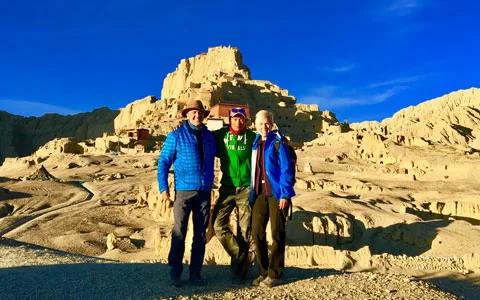
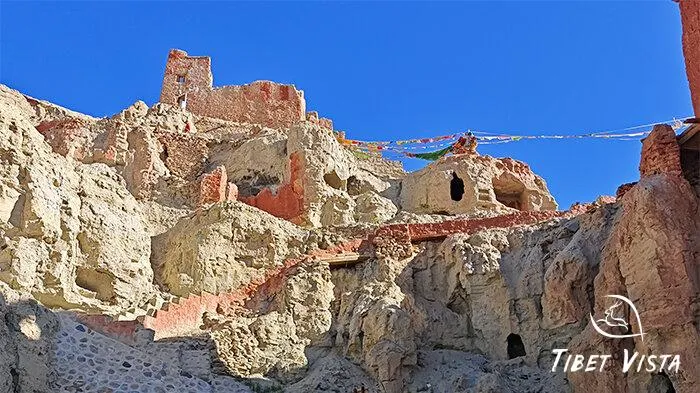 The remaining architecture and caves of the Guge Kingdom.
What to Explore at the Guge Kingdom: The Grand Palace, Frescoes, and Stupas
The Guge Kingdom ruins are a cluster of crumbling walls and broken buildings. Even in ruins, the fact that a kingdom was built at over 4,000 meters is remarkable. Key highlights include the grand palace, frescoes, stupas, the Mummy Cave, and the stunning sunrise over the site.
The grand palace rises more than 300 meters high from the ground. To date, 445 rooms, 879 caves, 58 pillboxes, 28 Buddhist pagodas, and 4 secret tunnels have been discovered, making it one of the must sees attractions in Ngari prefecture.
Surrounding the palace, parts of the city walls remain remarkably well preserved, with four pillboxes marking their edges. Throughout the ruins, artifacts such as farming tools, clothing, shields, and arrows offer a vivid glimpse into life in Guge over 300 years ago.
One of Guge’s most remarkable features is its frescoes. Many are influenced by Buddhism and depict figures like Yamantaka and Tara Buddhas. The Mandala Chapel, in particular, preserves records of Buddhist practices. The 28 stupas, pagoda-shaped Buddhist monuments, are scattered across the landscape.
The Mummy Cave, or Corpse Cave, lies over 600 meters north of the ruins, carved three meters above the ground into a cliff. Its small entrance opens into three connected chambers, containing headless mummified bodies.
Legend says the deepest chamber holds lamas, followed by children, women, and men. The dry climate preserved the bodies, which emit a faint odor. The most accepted story is that after Guge fell, Ladakh invaders executed soldiers who refused to surrender and left their bodies in the cave.
In Zanda County, Ngari, the sunrise over Guge and the sunset over the Zanda Earth Forest are also breathtaking. Watching the sunrise at the ruins is unforgettable: golden light illuminates the ancient citadel, blending with the earthen hills under a deep blue sky. The majestic ruins stand proudly while the scattered structures evoke desolation and the passage of time.
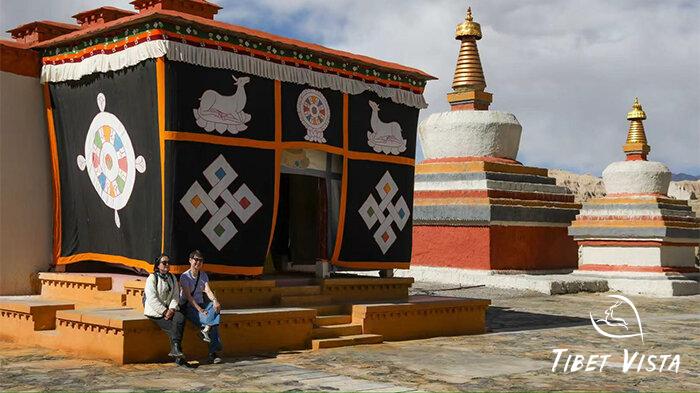 The Toling monastery near Guge kingdom.
Other Famous Attractions Near the Guge Kingdom and Recommended Itinerary
The mysterious Guge Kingdom is the main highlight of western Tibet. But the surrounding region also has many amazing attractions. Among them, there are Mount Kailash, Lake Manasarovar, and Toling monastery are also definitely worth visiting.
A few hours’ drive from the Guge ruins is sacred Mount Kailash, reverred by Buddhists, Hindus, Jains, and Bon followers, and considered the center of the universe. The mountain rises 6,638 meters and its perfectly symmetrical. Pilgrims travel from across the Himalayas to perform the kora, a 52-kilometer walk around the mountain, believed to wash away a lifetime of sins.
Nearby is Lake Manasarovar, one of Tibet’s three holy lakes. Pilgrims from all over the world gather around the lake to purify their souls. Many spend a night by the shore, enjoying the silence of the plateau and the star-filled sky.
Another must-visit site is the ancient Toling Monastery, once the spiritual center of the Guge Kingdom. Founded in the 11th century by the Indian scholar Atisha, Toling helped revive Buddhism in Tibet. Its temples still hold detailed murals and ancient scriptures.
The best way to visit the Guge Kingdom is through the 17-Day Kailash Manasarovar Full Moon Tour & Guge Kingdom Exploration. This trip not only includes the Guge ruins but also the highlights of Lhasa, a journey to Everest Base Camp and a three-day kora around Mount Kailash.
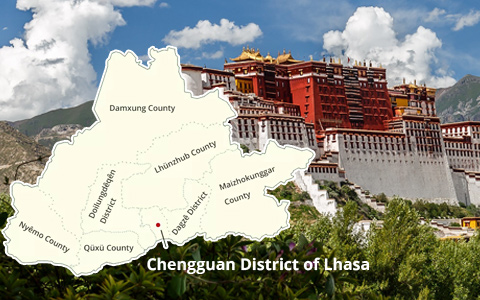
The journey begins in Lhasa, where you will experience its rich religious atmosphere, and iconic attractions. You will visit famous landmarks like the Potala Palace and Jokhang Monastery, watch monks debates at Sera Monastery and drinking Tibetan sweet tea in the teahouse like a local.
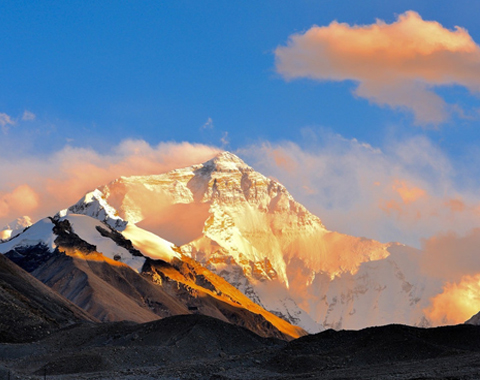
The tour then continues west through breathtaking sites, including touring Everest Base Camp and Rongbuk Monastery, the world’s highest monastery. After an overnight stay at Everest Base Camp, where you can admire the sunset, sunrise, and starry sky, you will travel to Darchen in Ngari to explore the Guge Kingdom ruins and Toling Monastery.
The tour reaches its peak with a three-day kora around Mount Kailash, one of Tibet’s most classic Kora routes. After completing the kora, you will visit Lake Manasarovar. This journey showcases the best of Tibetan culture and natural wonders, from Lhasa to far-west Ngari, just in one go.
 Mount Kailash Kora with close-up view of Mt.Kailash, the ultimate pilgrimage in Tibet.
Practical Tips for Visiting the Guge Kingdom Ruins
1. The best time to visit the Guge Kingdom is late summer or autumn. The area can be cold in winter and early spring, from late October to the following March. Also, no accommodations or restaurants are open in winter due to the harsh weather.
2. You can reach Guge by road from Lhasa, or fly from Lhasa to Ngari Gunsha Airport to shorten the journey to 2 - 3 hours. You can also enter Tibet from Nepal and visit Guge via Gyirong port.
3. Nighttime is perfect for photography the ruins under the starry sky. The sky and mountains create stunning shots. But Tibetan nights are very cold, so dress in layers and keep warm.
4. Daytime is best for viewing the frescoes inside the Guge Kingdom ruins. Photos are not allowed. You may need a flashlight, but respect the site and do not take pictures.
 Summer and Autumn offer a great window to explore Guge Kingdom with nice weather.
Conclusion
The Guge Kingdom stands as a silent witness to a vanished civilization that once illuminated the plateau with its faith and culture. Though its disappearance remains an mystery, its ruins, frescoes, and legends continue to captivate the imagination of tourists from all over the world.
The journey to Guge is not just an exploration of history. Whether you come to seek answers to Guge’s mystery, or to Kora around Mount Kailash and Lake Manasarovar, a journey we promises an experience that lingers long after you leave Tibet. Don’t hesitate to contact us to start your wonderful Tibet tour!

With exceptional passion and outstanding leadership, Mrs. Catherine has dedicated herself to Tibet inbound tourism and China tour for 15 years. As one of the handful females who see great potential of Chinese inbound tourism, Catherine has made great contribution to promoting Tibet tourism and enhancing the employment of Tibetans and prosperity of local Tibetan community.
Over the years, she travelled overseas with Tibet Tourism Bureau many times to promote Tibet tourism. Currently, Catherine works as the marketing director of Tibet Vista, an opinion leader behind the whole team of Tibet Vista.
 Email me about your travel idea
Related Articles & Posts
.jpg)
Most Popular Tibet Small Group Tour Packages
-
Lhasa - Gyantse - Shigatse - Everest Base Camp - Shigatse - Lhasa
USD949
View Details -
Lhasa - Gyantse - Shigatse - E.B.C - Saga - Kailash Trek - Darchen - Lake Manasarovar - Saga - Gyirong - Tingri - Lhasa
USD2069
View Details -
10 Days Lhasa to Everest Base Camp, Namtso Lake and Holy Elephant Gate Small Group Tour
Lhasa - Gyantse - Shigatse - EBC - Shigatse - North Tibet Grassland - Bange - Namtso Lake - Holy Elephant Gate - Lhasa
USD1299
View Details -
8 Days Driving Across Himalaya Overland Adventure from Kathmandu to Lhasa
Kathmandu - Gyirong - Everest Base Camp - Tingri - Shigatse - Gyantse - Lhasa
USD1019
View Details -
4 Days Lhasa Impression Small Group Tour: Explore the Heart of Tibet and Mingle with the Locals
Lhasa
USD509
View Details -
Lhasa - Gyantse - Shigatse - Everest Base Camp - Gyirong - Kathmandu
USD989
View Details -
Lhasa - Gyantse - Shigatse- Lhasa
USD799
View Details -
Lhasa - Gyantse - Shigatse - EBC - Saga - Darchen - Kailash Trek - Darchen - Saga - Gyirong - Kathmandu
USD2069
View Details
0 Comment ON "Explore the Lost Guge Kingdom: Travel Guide to Tibet’s Greatest Mystery"


The Geographic Facts and History of the Guge Kingdom in Tibet
Why the Guge Kingdom Disappeared Overnight: A Mystery That Still Remains
What to Explore at the Guge Kingdom: The Grand Palace, Frescoes, and Stupas
Other Famous Attractions Near the Guge Kingdom and Recommended Itinerary